Potsdam and Berliners
For the most part the weather has been nice and the people have been German—meaning: corrective. I think they have forever been corrective since the dawn of diutisc times (deutsch = of the people). They are all about the rules and will make it very clear if you have broken one. Sharp glares are a German pillar of society, as if you’re constantly being observed by a Catholic nun. It is a Catholic country and making excessive noise on Sunday can earn you a fine.

I also think there is some sort of generational guilt for WWI & WWII, as well. Indicative of their cardboard toilet paper, lack of tissues (let alone soft Kleenex). And their incredibly high pressure shower faucets—I now know what an automobile feels like in a carwash, and mattresses that feel like buckwheat floor pallets than anything close to a supportive night’s sleep. It’s as if the new generation feels undeserving of enjoying softer things. Or perhaps, I am just a soft American.

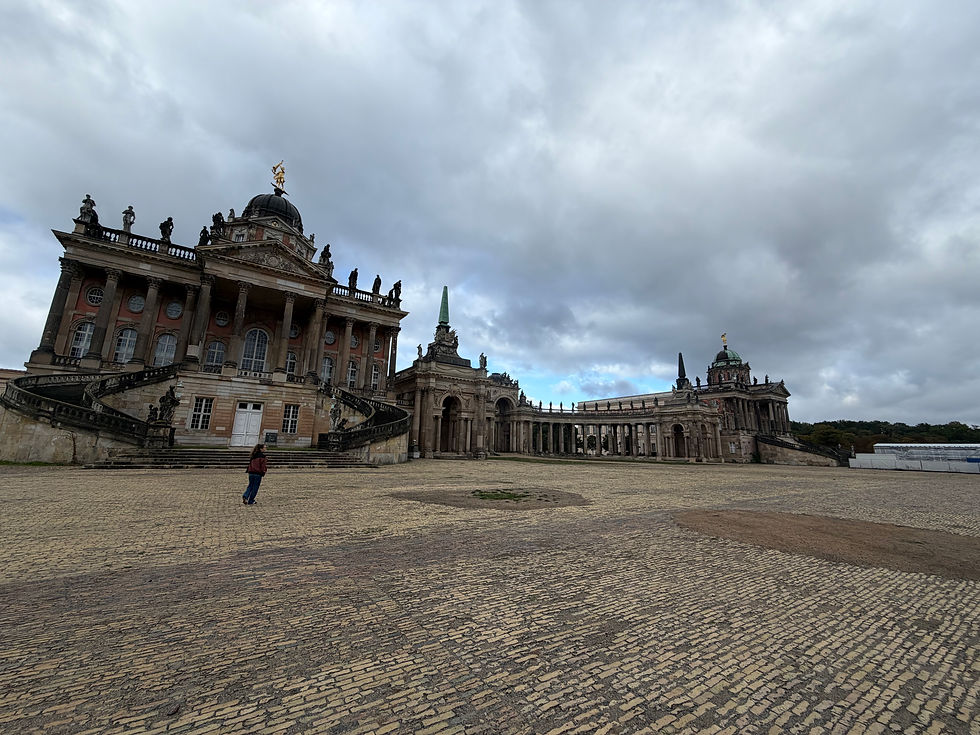
On this first day in Potsdam we took a drive around the old town where my daughter’s university is located. She told me it was at the Neues Palais of Sanssouci campus. Potsdam Universität is a relatively new college, established just after Reunification, and is now the largest university in the state of Brandenburg. The New Palace (which is older than the United States by seven years) was under scaffolding and likely won't be done by the time she leaves next year. It was in this opulent location (more later) that Kaiser Wilhelm II, on July 13th, 1914, signed the declaration of war, mobilizing German troops into WWI.

Directly across from this historic location are her lecture halls known as the Communs, built at the time of Frederick the Great (1763 to 1769, he reigned 40 years). Her master’s degree will ultimately earn her a double major in International War Studies and Diplomatic Policy. These buildings were the kitchens and serving quarters, as well as rooms for the lesser dignitaries; however, they, too, match Old Fritz’ flare for the Rococo. The halls consist of two large, symmetrical mirror-image service wings connected by a grand semicircular colonnade. I mean pretty impressive for being the out-buildings.

The next day we braved the train station and got a one-day ticket into Berlin. I think, maybe, a little providence (or the Adjustment Bureau) played a hand in my driving plans. I planned to drive into both Munich and Berlin. My relatives called me crazy to drive in Munich (which got aborted by flights), and with the decision to come to Potsdam early, we decided to learn the ropes of the train station. Potsdam is the opulent suburb of Berlin, and only 30 minutes from the Berlin Hauptbahnhof (“grand” central station). Apparently it is the “Hollywood” of Germany, where stars reside, and film TV and movies. Berlin would have been a nightmare to drive in, added to the fact that in two days time they were hosting the Berlin Marathon, and there would be a labyrinth of street closures.
We stayed at the Wilde ApartHotel, which was Irish in theme and located near Check Point Charlie. Also nearby was a walkable permanent exhibition of a section of the Berlin Wall and the Topography of Terror museum built on top of the original Gestapo prison and Secret Service (SS) headquarters. It was a sobering affair with a chronological history of the rise of Nazi power and the eventual fall. What struck me most was Hilter and Himmler (head of the SS) were both cowards who committed suicide in the end.
There were historic photos of German soldiers with smiles when they held guns to the heads of the Jewish people. The dehumanization was palpable. It is abominable that the US took so long to defend Europe against such fascism. It is abominable that there are people (sheeple) in our country today who are so stupid as to defend this type of power grab in the US. I am supposed to play nice, and see the humans of the MAGA movement as misguided—but they are objectively wrong. They will be on the wrong side of history. I refuse to be them, I refuse to dehumanize them, but I will continue to uplift the re-education of the excessively ignorant.

It was the undereducated that supported the Führer, and that is why the SS burned books at Humboldt University (where Einstein taught in Berlin, where 29 Nobel prize laureates hail). Scientists were gagged metaphorically and literally. Keep the people dumb and the sheeple will look for a dictator. The parallels between SS and ICE are sickening. The only saving grace is that when Hilter rose to power, Germany was facing 38% unemployment (probably closer to 50% if you included women—no stats). Highly due to the financial burden placed upon Germany by the Treaty of Versailles and Article 231, a massive war reparations act that was not repaid until October 3, 2010 (92 years later).

Of note, when the current US administration took office, unemployment was at 4.2%. We have a living Constitution, Germany was in political disarray and starving since WWI, and the news is faster and consumable today with more outlets. Germany was 70 million in 1940, USA is 343 million today. The size and scope difference is exponential; however, so is the wealth inequality that often leads to revolution or civil conflicts. Due to the Marshall plan after WWII, West Germany and 15 other Western European countries recevied 13 Billion in a recovery program. During the 15-month Berlin Airlift (June 1948 to September 1949), American and British forces flew between 277,000 and 278,228 total flights into West Berlin to deliver vital supplies and support the city's economic recovery. This did not include East Berlin. Interestingly, there were many mid-air collisions, and formulated modern air traffic control.

I can see now how Eastern Germany continued to suffer as compared to Western Germany (having witnessed 1989/1990 Russia), as the Soviet Union did not adequately support a recovery program. Up until 1961, the borders between East and West were somewhat fluid. The young were leaving East Germany for better opportunities, and creating a brain-drain. And, in part, on August 13, 1961, the Cold War began, East Berliners were prevented from crossing, literally over night. Barbed wire was run around the West border and Check Point Charlie was born.

I will say, there are very few unhoused in downtown Berlin today, and seemingly across Germany. Germany has a very expensive social contract with the employed: 50% in taxes (but don’t we pay this through our healthcare and our health? On top of our taxes.) I don’t know which “democratic” socio-economic system is better (probably not ours when you see our relative homeless) but I know dehumanization is gruesome and revolting, and not a solution.

The next day we took a morning e-bike tour through die Mitte (the Middle). This is the oldest part of the city. It is a challenge to determine old versus new. Partly because of the carpet bombing US forces laid out in WWII, and because they have had eighty years to rebuild. Due to WWII, many buildings crumbled, ~1.5 million people were displaced, and many iconic buildings, churches and räthauser (govt), burned instead of collapsed, other sculptures, etc. were salvaged, and a lot of rubble turned into road-base. My grandfather was in the Army Corp of Engineers and helped rebuild many of the roads and bridges in Berlin. My mother, ~8 years old, came over with Tutu (my grandmother) on the first civilian flight into Berlin, May 1946. She spoke fluent German for a time, and recalled she could smell the stench of dead bodies under the ruins.

It is a dichotomy of feelings—sympathy for the people, and disdain for what these people caused—85 million deaths and 6 million of those for being Jewish. Will our current administration cause 1 billion deaths and 10 million for being pan-ethnic? Let’s face it, most wars come off the heels of industrial advances, for which we are in the midst of.
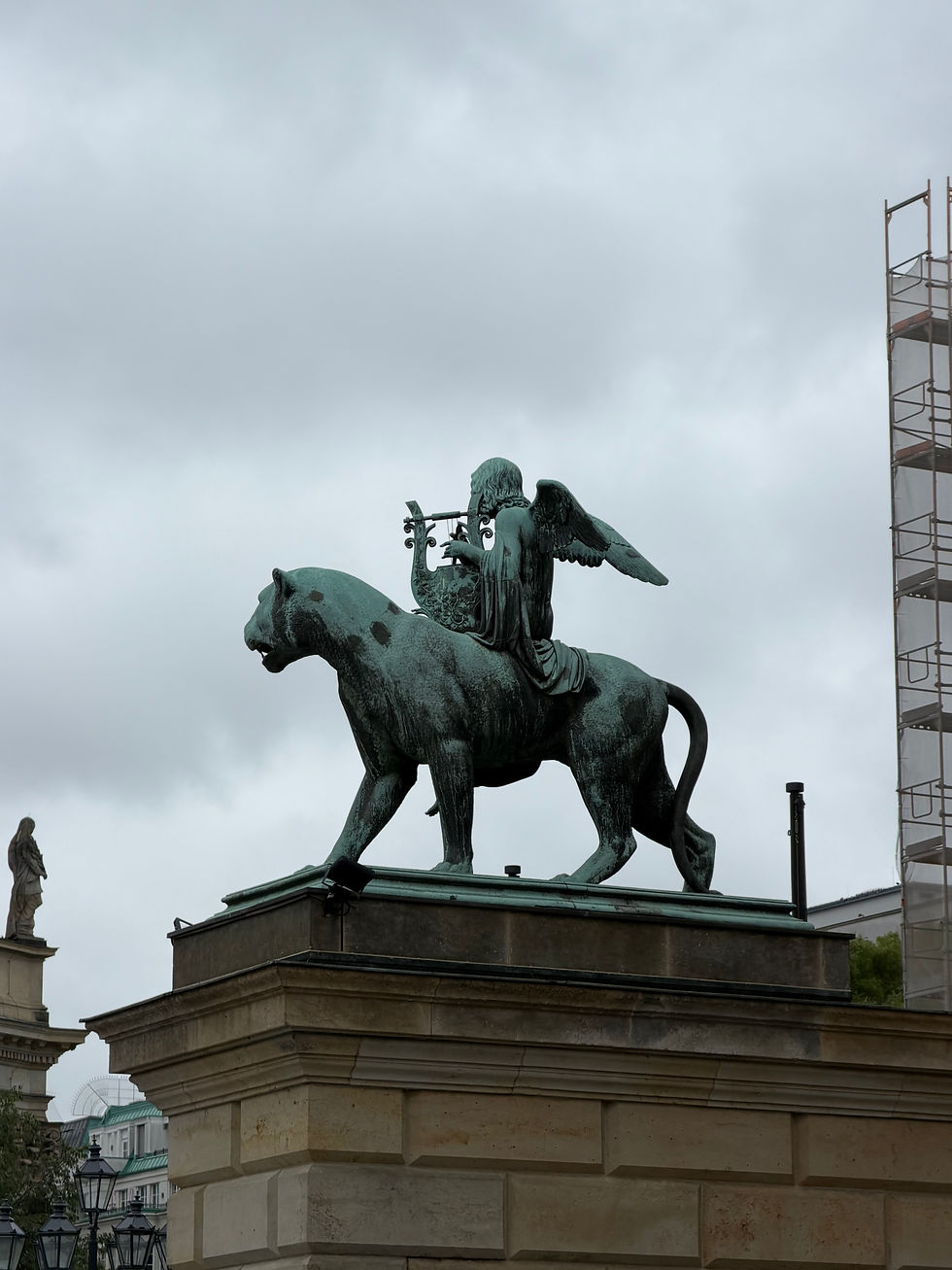
I highly recommend an e-bike tour. I booked through Unlimited Bikes. It took us quickly to several locations that by foot would have been grueling. I thought we would then decide on a museum from the guide suggestions—but nothing screamed at us. Included in pictures, we toured the Reichstag Building, Brandenburg Gate, Gendarmenmarkt, Alexanderplatz, Bebelplatz, the Holocaust Memorial, and Checkpoint Charlie.

The most impressive of all sites being the Holocaust Memorial. This memorial is a field of concrete blocks set upon an undulating landscape. Each block has the width and depth of a coffin, and all vary in height based on the earth. Laid out in a unified grid, the experience is both organized and produces a deep sense of disequilibrium.

I have been to the USSR (1989) and a year later to the Soviet Union—this Prussian era architecture contues from Moscow to Berlin, and drips with stucco rectangular buildings, Rococo influences, and Brutalism. Some buildings are harsh, some beautiful and ornate. Berlin is an architecture student's dream study.

Many churches remained untouched "by the hand of God,” or rebuilt and stabilized. The churches probably would have been interesting to see, but we, instead, did the Berlin Dungeon™️. This was my fifth Dungeon—Seattle, York, London, and Edinburgh. The show was in English, however the accents were thick, due to this it was harder to get into what is evidently a formulaic experience. Each Dungeon features local stories of bad characters, but once you’ve seen five, you’ve seen them all. Fun once, twice, and maybe even thrice.
On our walk home, we stopped at the “World’s Biggest Chocolate shop,” Rausch, a chocolate factory spanning ~16,150 sq. ft. across three floors. I bought some chocolate, but the gooey center is laced with hyperbole. The first floor was the chocolate shop, the second was the factory, and the third was a cafe with famous hot chocolate. Dairy is not on the diet plan, so we bought dark chocolate and some kirsch (cherry) liqueur. Fun, but not Charlie and the Chocolate Factory fun.

That evening we went down to the little cafe associated with our hotel for a glass of wine. The intention to sit and relax. The receptionist had other plans. He was a handsome 28-year-old man, and he decided he was going to have a full conversation with us. He was of Afghan descent but born in Germany with plans to move to Houston where his cousin lived. He had so many high hopes, I hated to tell him his dreams were simply that. He’d face racism and no socialized health system.

He wanted to take us to a Persian restaurant in Potsdam and gave my daughter his number. She kindly accepted it, but there was just a slight air of honey-trapping, so needless to say, while he likely was a perfectly okay guy, my daughter had no intention of reaching out to him. Perhaps, my subtle racism shows here, but it’s hard not to fall prey to concerns of bad players when your daughter is living alone in Europe. He did comp our wine and gluten-free brownie--despite our offer to pay.


Our hotel was half-a-block to Check Point Charlie, so we walked down in the morning and took our photos without any crowds. On our e-bike tour mid-day, it was 20-persons deep, likely due to Marathoners (September), but I imagine it is just as busy during the summer. Then, I finally ordered what I originally knew—an Americano (which I had been deterred from early on) and a Berliner, the iconic donut—we’d call it a jelly-filled donut. Theirs is a bit lighter without the fried crust—better than our version. So, I sipped my proper-sized coffee and gazed at my daughter with awe. She is doing something amazing and scary and wonderful.

We called a taxi and zoomed around the marathoners all virtue signaling their abilities, jogging it out. I mean, if you’re going to run a marathon, Berlin is as good as any. It’s at a low elevation and flat. Berlin means swamp, so instead of draining the capital of Germany, run around it, I guess.
We arrived in Potsdam on Saturday afternoon. My daughter’s apartment was nearly kitted-out; however, there was no quick food warming except a panini press. At our house, we have long since given up the microwave, opting for a steam-oven and air fryer. So we went to the shopping mall and got her an air-fryer. It was half-off. I don’t think the concept has taken over Germany yet, so yay us. She’ll leave it here when she moves to Dublin. Maybe she’ll sell it. But, I am sure she will use it—a lot. I then checked into my original hotel booking that I could not cancel, an AirBnB up SEVEN flights of stairs! It was central to Sanssouci Park (the palaces of Fredrick II “the Great,”) and the Dutch Quarter. This location provided a parking place where we could then stroll and discover the area further. So, at least there was that. But I definitely got my steps in!


There are several palaces and other ornate complexes built throughout this 740-acre greenland space. It reminds me a bit of Central Park in New York—huge public grounds protected from urban development. There is a lot to read about “Old Fritz.” He reigned for 40 years and died in his throne (actually he died in his favorite armchair in his bedchambers specially designed to lay back). He had a tyrannical, abusive father that forced him to study military prowess but Fritz was a lover of Enlightenment. He achieved both expansion of the Prussian borders, declaring himself the King of Prussia, and supported Voltaire for three years. Truth is, he was forced to marry but never lived with his wife. Never had children. And, the fountains around the grounds are rather phallic in design. While never confirmed, there is strong evidence that, much to his father’s chagrin, he lived an alternative, even flamboyant, lifestyle—as evidenced by his eponymous Rococo decoration style.


Across from my daughter’s lecture halls is the Neue Palais, built by Fredrich, completed in 1769 at the end of the Seven Years’ War, and is considered the last great Prussian Baroque palace. This building was built to house dignitaries and royal functions, including a women’s floor. Of note is the Grotto Hall (ballroom) with 24,000 seashells, quartz, coral, and other exotic under-the-sea natural decor. While it was not lighted as intended, it is obvious that if the candelabras were lit, the room would glimmer with an underwater feel. Above this ballroom was another named the Marble Hall. And as soon as this room was built, the floor began to sink, the support structure being insufficient to hold all the marble across the 240-sq.-ft. span of the Grotto. The palace continues wth many halls and rooms in all its gilded glory.


It was here that Kaiser Wilhelm II and his Empress Augusta Victoria lived and introduced modern electricity, steam heat, plumbing, and telephones, and the Kaiser (King) signed the army mobilization orders, and eventually exiled from. There are two marks of WWII graffiti, originally hidden from historians, now included as part of the history. Russian soldiers carved 1945 in the Old Sanssouci Palace and Death to Germans written in Cyrillic with red paint and charcoal. Some items were hidden underground and spared; Meisen chandeliers, original artwork by Peter Paul Rubens, Anthony van Dyck, Artemisia Gentileschi, and Guido Reni, many items went with the Kaiser into exile on a 34-train wagon collective, some were looted, and a little bit has been repatriated.

For dinner, we strolled the Dutch Quarter, which is a quaint shopping district and weekend market area. By this point, it is getting hard to believe I leave my non-German speaking daughter in a day's time.

As I write this, I have driven from Berlin to Munich on the Autobahn to catch my plane back home. At the Airport HIlton, all around me, are Americans traveling home after heavy drinking at Oktoberfest. It feels loud. Americans are loud. I want to stay immersed in a foreign language. I want to continue speaking my broken German. I want to be my soft-spoken Amerikaner trying out my second language, knowing they will patiently switch to English when I no longer make sense.

She cried. I don’t blame her. I would not allow myself to cry, I had to take on her fears and be her confidence, be her soft tissue. All the intrusive thoughts over her welfare filled my head at the same time knowing she is more capable than I was, and today, she does not need to rely on a paperback translation dictionary. She’ll navigate her way and be stronger for it.

Send your kids away. Have them do things that challenge their comfort zone. Rewrite your disquiets into an adventure!


Comments